OT/IT gateway · Windows and Linux · cloud-free
Every PLC in your plant, connected.
Without extra layers.
Nodaris OT reads and writes Siemens, Rockwell, Mitsubishi and Modbus PLCs with their native protocols and delivers all the data to SCADA, MES and historians over OPC UA, REST and MQTT. One executable, no external runtime, even in isolated networks.
Lightweight, secure, cloud-free
The gateway for the people who keep a plant running: few parts, all documented, and no dependency on external services.
Lightweight
One native executable: no Java, .NET, Node or containers. Under 200 MB of memory for eighty PLCs. Channels are included in the licence, not sold separately.
Secure
Tools for NIS2: hash-chained audit log, syslog to the SIEM, two-factor authentication, domain users, HTTPS and encrypted OPC UA, signed updates.
Cloud-free
No external services and no online licence check: it works in isolated OT networks. Configuration lives in plain text files you can read and version.
Made by people in the field
It comes from the communication servers DYNACOM runs in production at its customers' plants, every day.
A single point for all plant connections
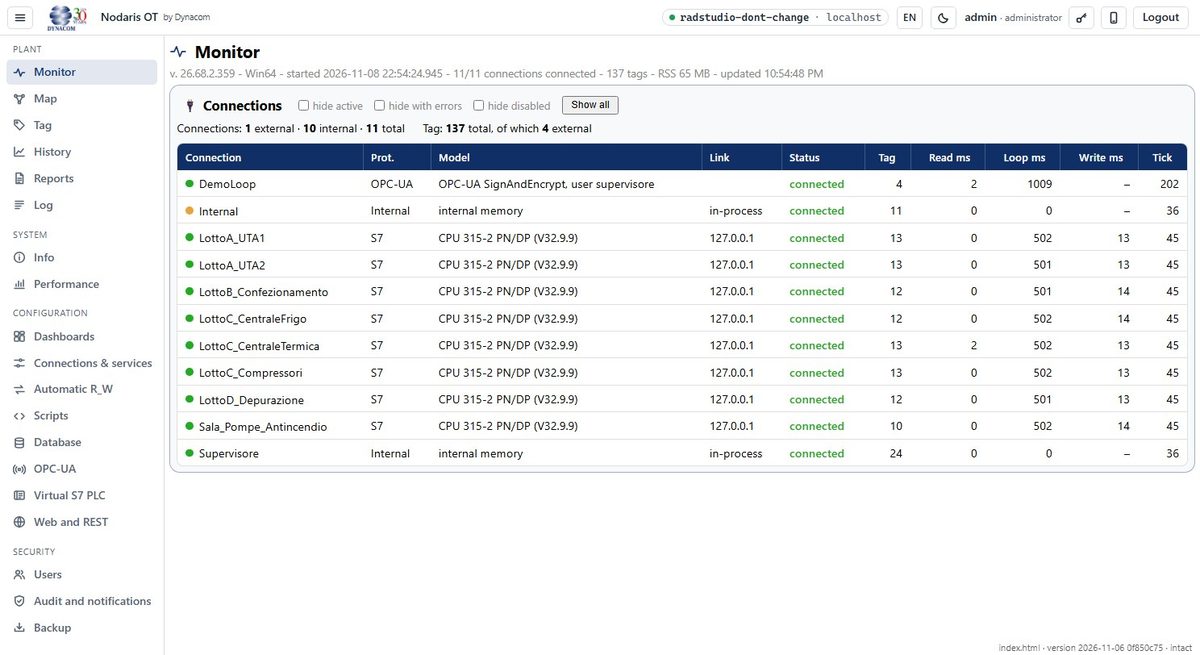
Nodaris OT works inside the OT network: it holds the connections to all the PLCs, puts their tags in one shared memory and copies them from one PLC to another, even across brands. Whoever needs that data takes it from there, and when required it also goes out to the IT network.
Field
Siemens S7-300/400/1200/1500 S7-1200/1500, optimised DBs Rockwell ControlLogix / CompactLogix / PLC5 Modbus TCP / RTU over TCP Mitsubishi MELSEC (SLMP) OPC UA servers · WinCC Unified · MQTT Other Nodaris OT nodes Nodaris OT
shared tag memory · automatic copies between PLCs · internal tags · scripts and databases · history · event log
Windows (service) · Linux IPC · high-availability cluster
Who uses the data
SCADA and HMI over OPC UA Department monitors and built-in web pages Historians and Grafana MQTT brokers MES and ERP over REST/JSON, when neededWhat sets it apart
Things that usually take three different products, in one.
S7-1200 and S7-1500 with optimised DBs
Symbolic access to the optimised DBs, even with PUT/GET disabled, without touching the PLC program.
High availability
Two IPCs in an active/passive cluster with a hot standby and a virtual address for clients. Failover measured in the field: 29 seconds from the loss of the node, of which promoting the standby takes less than one. With the HA passive node option, included in Enterprise.
Plant logic without extra software
Automatic tag copies between PLCs of different brands, internal tags, Pascal, Basic or JavaScript scripts on a cycle or on an event, with access to SQL databases.
Everything from the browser
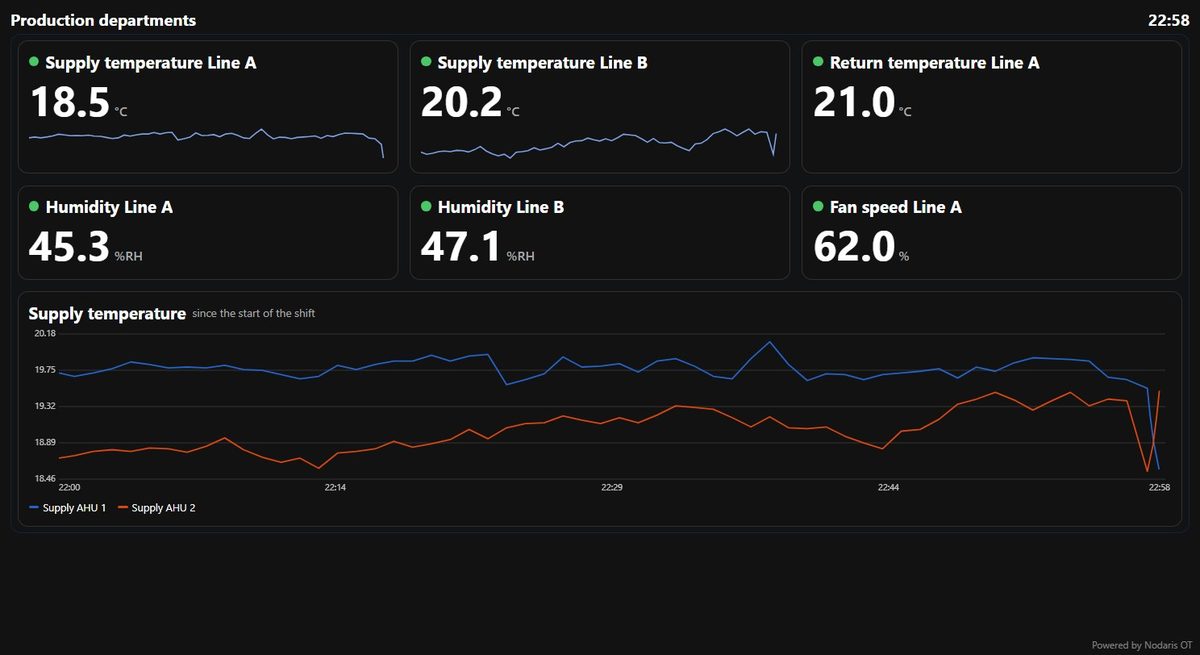
Monitor, tags, configuration, dashboards for department monitors, users and audit: pages served by the server itself, no client to install.
Figures from the field
Measured on the cluster of a plant in production, November 2026.
Who it is for
- Integrators and machine builders who need to expose a machine or a line over OPC UA without a hardware gateway.
- Plants with a mix of Siemens, Rockwell, Mitsubishi and Modbus to bring into a single SCADA or MES.
- Continuous processes (water, energy, chemicals, food) where the data server cannot stop.
- Anyone who wants fewer layers: classic OPC and scattered scripts replaced by one maintained, documented component.
Let's see it on your plant
A demo with your own PLCs, in an isolated network if needed. Write to us: engineers answer.